
Over the past decade, parents have been told again and again that “screen time is bad,” but rarely have we seen research this clear, this large, or this alarming.
A new landmark study one of the largest brain‑imaging studies ever conducted on children confirms what child psychiatrists like Dr. David Rosenberg have been warning for years:
Excessive screen time is physically changing children’s brains and not for the better.
And yet, there is good news. The same research shows that real‑world, face‑to‑face, creative, expressive activities can help protect and strengthen the very brain regions being harmed.
This is exactly where Drama Kids comes in.
🧠 What the New Study Found
The study referenced by Dr. Rosenberg comes from the NIH Adolescent Brain Cognitive Development (ABCD) Study, which has followed 11,000+ children over multiple years.
Key findings:
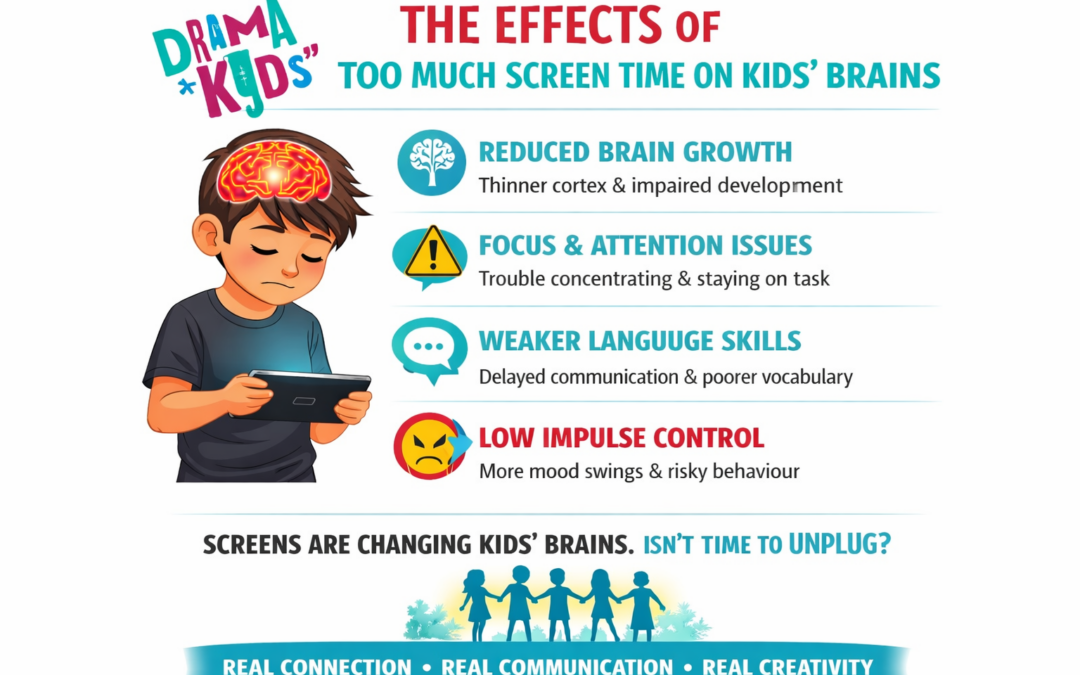
- Children who spend more than 2 hours/day on recreational screens show reduced cortical thickness a marker of slower brain development.
- Heavy screen use is linked to weaker language skills, reduced attention, and lower impulse control.
- MRI scans show measurable changes in the prefrontal cortex, the area responsible for decision‑making, emotional regulation, and social behaviour.
Sources:
- NIH ABCD Study Overview: https://abcdstudy.org/scientists/
- JAMA Pediatrics Publication: https://jamanetwork.com/journals/jamapediatrics/fullarticle/2754102
- Dr. David Rosenberg Profile: https://psychiatry.med.wayne.edu/profile/aa8933
⚠️ Why This Matters for Parents
Children’s brains are still wiring themselves every experience strengthens or weakens neural pathways.
Screens deliver:
- Instant dopamine
- Passive stimulation
- Fast, shallow engagement
But children need:
- Real conversation
- Movement
- Creativity
- Emotional expression
- Problem‑solving
- Human connection
These are the exact ingredients missing from digital environments and the exact ingredients Drama Kids delivers every single week.
🎭 How Drama Kids Helps Protect and Strengthen the Developing Brain
Drama Kids isn’t about performing. It’s about building the brain.
Our classes activate the areas screens suppress:
✔ Prefrontal Cortex (focus, decision‑making)
Drama activities require planning, listening, and responding in real time.
✔ Language & Communication Centres
Children speak, improvise, articulate, and express ideas out loud.
✔ Social & Emotional Networks
Drama builds empathy, emotional regulation, and confidence.
✔ Motor & Sensory Integration
Movement, gesture, and physical storytelling strengthen whole‑brain learning.
Parents consistently tell us:
“My child is more confident.” “They speak up more at school.” “They’re calmer and more expressive.”
📚 Additional Research Parents Should Know
- Canadian Paediatric Society Screen Time Guidelines: https://cps.ca/en/documents/position/screen-time-and-young-children
- Harvard Medical School Screen Time & Brain Development: https://www.health.harvard.edu/blog/too-much-screen-time-may-affect-childrens-brain-development-2018122715551
- University of Calgary Meta‑Analysis (89 studies): https://jamanetwork.com/journals/jamapediatrics/fullarticle/2764395
🌟 The Takeaway for Parents
Screens aren’t going away but we can balance them with experiences that build healthy, resilient, confident brains.
Drama Kids gives children:
- Real human connection
- Real communication
- Real creativity
- Real confidence
- Real dopamine the healthy kind
And that’s something no app, no device, and no screen can ever replace.
🚀 Learn More
Find a class near you: https://www.dramakids.ca
In‑school programs: https://www.dramakids.ca/inschool-programs
Franchise opportunities: https://www.dramakidsfranchise.ca